
The Programme: Substack live today midday
Hipster ice cream, boobs and vibrators for 12 year olds?

So Anna Wharton, Jennifer Cox and I are starting to do weekly Monday lunchtime live chats. We talk about life, health and sexism while eating random foodstuffs. Last food category was weird ice creams. I tried a gross vegan pistachio, baklava, cinnamon and orange blossom ice cream (three ingredients too many) and also a very delicious mochi chocolate thing. Mochis are ice cream in little rice sacks. Look like cute cartoony testicles - taste gorgeous and feel heavenly in the mouth. All squishy and sweet.
I almost bought an ice cream called The Gay One but then didn’t. It was getting too expensive but I am pleased the despite cost of living and global war, hipster ice creams are alive and well in our corner of East London. Of course they are.
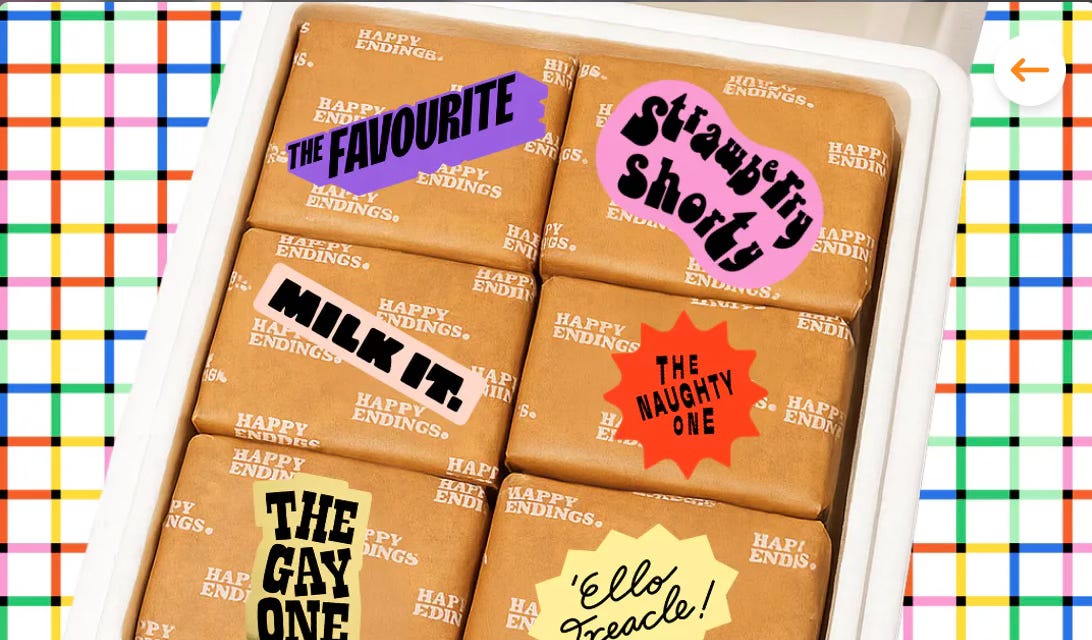
But then Anna’s health stuff got flared up after eating so much sugar and so we are letting go of the food concept for a while. Turns out we can just chat quite happily without sugar.
We are toying with what to call it. We were going to call it Bad Housekeeping if we kept the taste tests going. We would be like the Good Housekeeping Institute but not that good. Then we thought about something like What We Chat about on our WA group. But that’s a bit long. Right now we are settling for The Programme. Because that’s what Anna’s mum refers to it as. She says our last episode - where we talked about Anna’s run in with the school about her daughter’s school uniform and where I dropped the bombshell that I had just heard of someone who gave her daughter a vibrator at 12 - was her favourite one of The Programme.
So there we are for now: The Programme. I think we are like the Loose Women of Substack minus the make up or brightly coloured dresses, which makes me smile. My dad loved Loose Women. In the years before he died he watched a lot of television but the Big Bang Theory and Loose Women were his favourites. He used to tell me he thought I’d be good on telly - said I’d be like Maevis Nicholson, who I had not heard of but on googling, I took it as a huge compliment. Look at her here interviewing Maya Angelou, it’s a gorgeous conversation.
One of the things we have talked in the last episode of The Programme was how after we do any public speaking - on stages, on podcasts, on our Substack Lives - we will be hit with a shame / fear spiral that says that everything we said / did was crap, that we never should have done it etc. Anna’s fear is that she sounds stupid. Jen thinks that people hate her. I feel terrified that I said something that is a criticism of someone and that I will have pissed off a colleague, friend or relative. I also worry that I come off as serious, square and self-pitying. If I watch bits of me back I think ‘lighten up love!’, I look so pained, so earnest…
(In fairness Lighten Up, Love might be a good tattoo to consider for the ongoing mid-life crisis. Or I could get a poster made.)
Anyway, I am fine while doing the talks - during the chat itself I feel like charm on a stick - but afterwards I want to hide in a hole and pretend it didn’t happen. It’s why I never share any of the podcasts I’ve appeared on and it took me five years to share the Ted talk I spent months preparing.
We talked about what is going on with this - and how deep rooted it all is.
Jen is a therapist and so she knows stuff. She knows there are archetypes that women are put into: The Good girl, the Mad woman, the Whore etc. Anytime we are in the world we are potentially being put into one of those categories.
All my life I have been the Good Girl - but as I get older I worry I am heading into Mad Woman territory. But maybe that’s not anything to worry about. Maybe it’s good.
I have a friend who has regular sore throats. ‘It’s the witch wound,’ she’ll say casually.
The witch wound for those of you not immersed in spiritual and woo workshop land - refers to the fact that women were historically killed for speaking out. There is a theory that some part of our body and soul carries this memory and so we stay quiet and this silencing of ourselves can result in sore throats.
We talked on the Substack Live about how much famous women are punished by society (esp other women) for daring to be visible. The world criticises them, judges them, tears them down online.
But we also do that to ourselves.
Nobody has ever been as savage to me as I have been to myself. I have spoken at events where my take on free love and sex has not gone down well. There has been the most awkward of silences. Blank faces. People looking down at their laps. But actually nobody ever attacked me.
They didn’t need to, for days afterwards I will be in a self-destructive spiral of wishing I hadn’t said something, or had said something else.
I find ways to punish myself for daring to speak out in public, ways to put myself back in my box. My place. Which is - obvs - to be quiet and nice.
When I do public speaking events there will usually be questions at the end.
Time after time a woman will stand up and say something honest, brave and vulnerable - something that half the women in the room will be nodding to - and she will then finish it by saying ‘Sorry, that was over-sharing’.
It breaks my heart. It was not over sharing - it was generous and helpful.
Categorising us using our voice as ‘over sharing’ or TMI - is a way of diminishing not only the thing we said and also our need and right to say it. And it affects all of us.
So can we pls stop doing it?
Look at all the terrible voices that are being heard these days. Look at how they are destroying our world. And we are apologising for speaking? Or more likely, sitting in silence because we don’t think what we have anything important enough to say.
It’s not up to us to decide if what we are saying if of use or not. We may never know the impact we have on someone else by speaking out and up.
In a recent post Laurie Stone (whose writing I adore) was remembering the cosciousness raising groups of the 70s, where women came together to talk about their lives and they realised that what affected them in their private lives was always the sign of bigger systemic problems. The personal was political. Stone talks about how women are told to stay quiet because some things should be kept ‘private’. This quiet is sold to us as dignity but according to Stone: ‘Where women are concerned, the word “privacy” is code for, “You, don’t open your mouth, no one cares what you think.” Also, it’s code for: “You should be ashamed.”’
Fuck that.
Anyway - all of this is to say we are doing another Programme today at midday, here on Substack. We plan to talk about money and how we make it - or don’t.
xx
Oh and boobs! We also talked about boobs in our last chat. I had not hear this before but apparently there is a therapeutic approach that divides the world into ‘Good breast’ and ‘bad breast’. According to psychoanalyst Melanie Klein, as babies, we cope with overwhelming needs by splitting caregivers into two extremes: a perfect “good breast” when they comfort and feed us, and a terrifying ‘bad breast’ when they are not there. In healthy development, we eventually learn that good and bad qualities exist in the same imperfect person, building our capacity to hold complexity. Under stress or trauma, though, adults can regress to this all-or-nothing thinking, losing the ability to see people in shades of grey.
I had never heard of Klein before but she was a follower of Freud and v important in the field of childhood development.
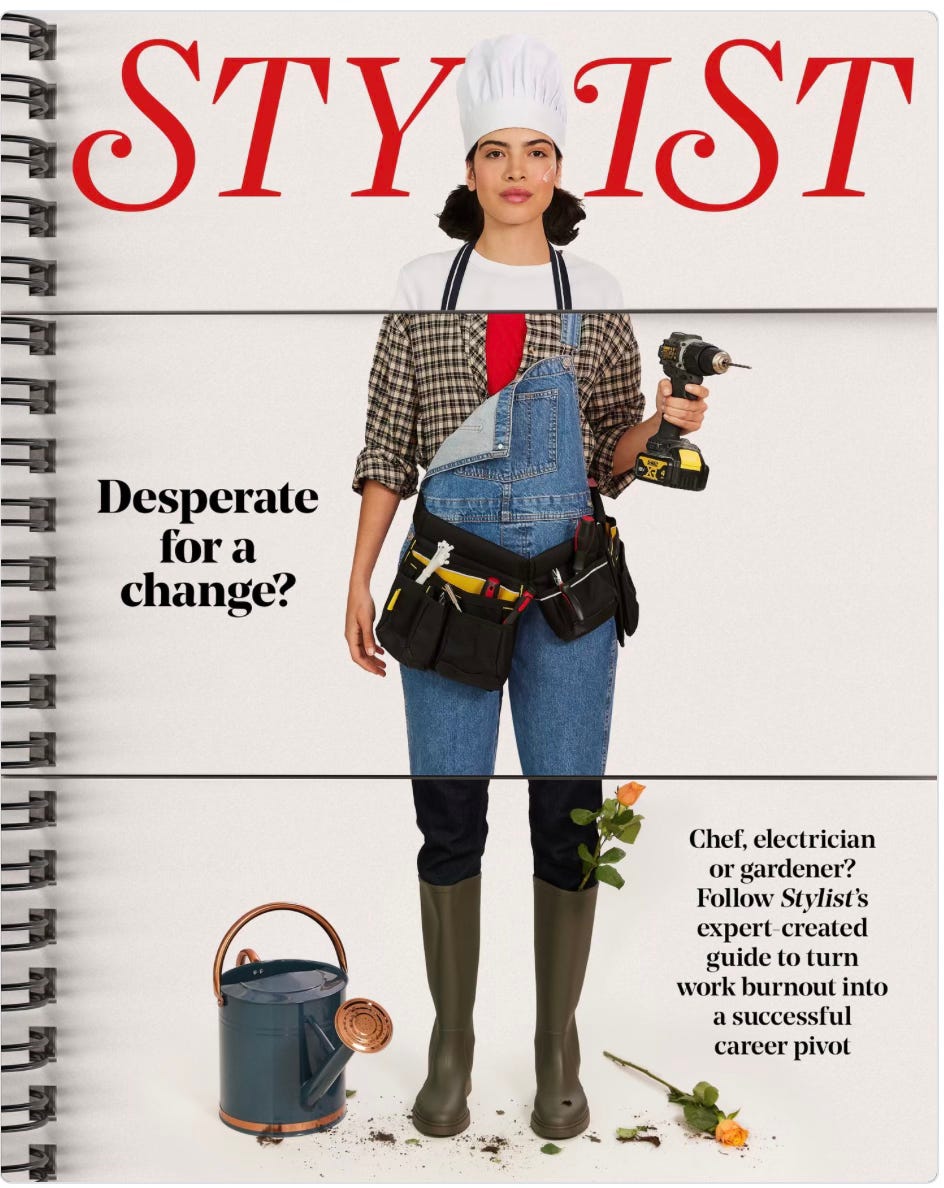
Thank you very much for the response to the piece on exhaustion. I worried it was a boring miserable piece and almost didn’t share but it seems a lot of you are in this place at the moment. We are in a huge melting down phase, it seems - so many of the old rules and structures and goals, no longer work. We are in the mucky chrysalis trying to figure out what next. As this cover of Stylist magazine would suggest:
I have started reading Wise Power a book about menopause - which came out in lockdown. The authors run the Red School and they see symptoms of menopause getting worse every year. They wonder if it is connected to the state of the world - and that the more out of balance the world is (climate, politics, work, money etc) the more it shows up in our bodies. It makes total sense. Also the book is hugely reassuring. It describes so much of what I’ve been going through.
I also really got a lot from this piece by Jameela Jamil.
And this article summed up so much of what’s been on the edge of my thinking.
The world’s going mad, so potentially am I, and weirdly today that feels just fine.
The sun is shining, I’m in the coffee shop about to chat to two clever funny women in a couple of hours.
Life is good, despite it all.
xx
"It’s not up to us to decide if what we are saying if of use or not. We may never know the impact we have on someone else by speaking out and up." This is something I'm struggling with a bit right now. What to write and why. There are so many messages that the world needs our stories. And it does. But sometimes, for me, it tips into a feeling of obligation. I have written about painful experiences (some published here, some never shared anywhere), but I get tired of the sad stuff. It's too much sometimes. And publishing leads to other conversations (mostly kind and compassionate) that take me further down a painful path. And sometimes, I just want to shake it off entirely. I know it's up to us, what we write and share, but sometimes *that* in itself is unclear. What do *I* want? And what's good for *me*? Appreciate you, as always. The TMI/oversharing point matters. Whenever a friend tells me something very personal and says: Was that TMI? I tell them, with me, there is no such thing.
It's what you want to keep private, not everyone can keep their cake hole closed. Be mysterious, like Eva Stratt in Project Hail Mary. Speak to people you really trust, Mushroom everyone else (keep them in the dark, feed them s**t)
I'll watch your money talk, I might pick up some tips.